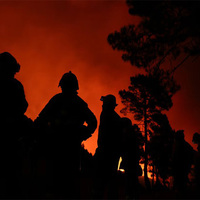


(CN) - Wildfires raged out of control on Monday across western Spain and Portugal, prompting European allies to send in firefighters and equipment to help squelch a wave of blazes that have killed eight people, forced thousands to flee and scorched an area larger than the Grand Canyon National Park.
The devastating fires on the Iberian Peninsula add to what has become one of Europe's worst years on record for wildfires. This fire season has seen major blazes break out in France, Cyprus, Greece, Italy, Montenegro, Albania, Turkey, Bulgaria and elsewhere. So far, about 2,325 square miles of land across Europe have been scorched.
"2025 is on track to become the worst year on record for burnt area," said Alfredo Branco, a wildfire expert at the Joint Research Center, a European Union science agency, in an email to Courthouse News.
For comparison, 2017 saw the most extensive damage ever recorded when wildfires burnt 3,814 square miles and 2022 was the second-worst with 3,439 square miles of scorched land.
For the past week, Spain and Portugal have been battling major wildfires amid an intense heat wave that has seen temperatures soar past 100 degrees Fahrenheit across much of the Iberian Peninsula.
Scientists say climate change is making heat waves more intense and longer and that in turn makes wildfires more likely to break out and grow.
Branco said long-term fire data "indicates a slight increasing trend in the proportion of total burnt area attributed to large fires" in Europe.
By Monday, about 1,330 square miles had burned in Spain and 664 square miles in Portugal, making this the worst year in decades for wildfires on the Iberian Peninsula.
With temperatures expected to recede by Tuesday, Spain's State Meteorological Agency said the cooler temperatures should help dampen the fires, though it warned the country against letting down its guard.
The Iberian Peninsula has endured 16 days of scorching heat in what has been Spain's third longest-lasting heat wave since records began in 1975, according to the State Meteorological Agency. Heat waves in 2022 and 2015 lasted longer.
In Spain, one of the worst-hit areas was the northwestern Galicia region. Fires raged in nearby regions too, forcing authorities to close sections of the famed Camino de Santiago pilgrimage trail as fires spread to the southern slopes of the Picos de Europa mountain range.
The scenes from Spain have been horrendous with flames devouring forests, mountainsides, farms and dozens of homes.
"Every single feeling is going on," said Juan Picos, a professor of forestry at the University of Vigo in Galicia, in an email. He described the region as living through a "nightmare" where "people felt at risk or lost their homes, farms and forests."
He said the devastation underscored the urgency in taking the risk from wildfires seriously.
"With so much energy stored in the landscape (due to the abandonment of agriculture, grazing and forest management) and a lot of energy stored in the atmosphere (climate change) any situation that allows these two huge energies to connect will lead to a catastrophe," he wrote.
In Portugal, the largest blaze was near the mountainous area of Piodao, but firefighters battled several major fires in central and northern Portugal.
Spain has deployed about 4,000 soldiers to help local firefighters combat the fires and several European nations are helping too.
Spanish Defense Minister Margarita Robles told Cadena SER radio on Monday that the country's military emergency unit had "not seen anything like it in its 20 years" of activity.
France, Germany, Italy, the Netherlands, Finland, the Czech Republic and Slovakia have sent about 200 firefighters as well as several water-dumping airplanes and helicopters.
The fires have killed at least eight people in recent days across southern Europe, including a firefighter who died Sunday when a fire truck overturned on a steep road in Leon and slid down a hillside.
On Monday, the Spanish Interior Ministry said more than 31,000 people have been evacuated from their homes since Aug. 12. The police have arrested 31 people suspected of setting fires, the ministry said.
Courthouse News reporter Cain Burdeau is based in the European Union.
Source: Courthouse News Service